TL;DR
Ethical SEO is the process of improving a website’s search visibility through practices that follow search engine guidelines, serve users honestly, and create genuine value. It means earning visibility fairly by building useful experiences, trust, and credibility, while avoiding misleading, manipulative, or exploitative tactics. The focus is on sustainable, long-term organic growth rather than shortcuts that may produce temporary rankings at the expense of users, search engine guidelines, or the business itself. White-hat SEO sits within this broader framework as a subset of ethical SEO, rather than being the same thing.
Ethical SEO is often misunderstood
There is a lot of confusion in the SEO industry about what ethical SEO is and what it isn’t. In this article, I will settle this debate and go a bit further to show some recent trends in the SEO industry around the ethics of SEO and its demand.
Ok, let’s start with the basics.
What is ethical SEO?
Ethical SEO is the process of improving a website’s visibility in search engines by combining two key parts:
1. The white-hat SEO part
This is the part that has to do with search engines and focuses on using white-hat SEO practices that adhere to official search engine guidelines.
2. The social impact part
This is the part that has to do with people and focuses on applying SEO with honesty, transparency, integrity, and responsibility towards them. It means avoiding shady tactics that may increase visibility but mislead, deceive, manipulate, or exploit users.
In short, ethical SEO means improving a website’s search visibility through practices that adhere to search engine guidelines, serve users honestly, and create genuine value for the purpose of earning visibility fairly, while building user trust and prioritizing long-term credibility over shortcuts or manipulation.
Personally, as an ethical SEO consultant, I take it a step further because I have decided not to work with businesses that operate in industries that I consider unethical. Adult entertainment, gambling, addictive video games, and different vices, such as smoking and vaping, alcohol, CBD, unhealthy foods, etc., are industries and business models that I do not work with for ethical reasons. This could also be part of ethical SEO, although it’s not as clear-cut as the above two points, because not everyone has the same moral compass, and it’s more of a personal point of view of the world than an objective rule.
Before we move on, let’s define what unethical SEO is as well, because that’s also very important for comparison.
What is unethical SEO?
Unethical SEO is the process of improving a website’s visibility in search engines by combining two key parts:
1. The black-hat SEO part
This part, the opposite of the white-hat SEO part, focuses on using black-hat SEO practices that violate search engine guidelines.
2. The social impact part
This part focuses on applying SEO without honesty, transparency, integrity, and responsibility towards users. It means using shady tactics that might increase visibility but could also mislead, deceive, manipulate, or exploit users.
In short, unethical SEO means trying to improve a website’s search visibility through practices that violate search engine guidelines, manipulate rankings, and mislead, deceive, or exploit users for the purpose of gaining unfair visibility, while damaging user trust and prioritizing rankings over value creation and long-term credibility.
Okay, with that being said, I have covered ethical and white hat SEO, as well as unethical and black hat SEO. But there is still one area I need to address: grey hat SEO.
Grey hat SEO is often considered the most controversial part of SEO because it exists in the unclear space between white-hat and black-hat practices. Some grey-hat practices may be viewed as white hat by some SEO experts and black hat by others, depending on how they interpret search engine guidelines. This open interpretation is where much of the confusion, debate, and disagreement around grey hat SEO comes from.
Let’s cover grey hat SEO as well, so we can make sure no stone is left unturned.
What is grey hat SEO?
Grey hat SEO is the process of trying to improve a website’s search visibility through practices that sometimes violate search engine guidelines or, at the very best, sit in a grey and debatable area of SEO.
These practices are mostly focused on trying to manipulate search engine algorithms in the website’s favor and are not as focused on users.
They usually don’t cause any harm to users, although they can sometimes do so indirectly. However, they do not always fall under the “allowed” practices in search engine guidelines.
The problem with grey hat SEO
The best example of grey hat SEO is off-page SEO, also known as link-building or backlinks, which I like to call “the necessary evil of SEO.”
Anyone who has been doing SEO for more than a few years understands that backlinks are a very important ranking factor. Here’s the catch, though. The guidelines specifically state that buying backlinks or exchanging products or services for them is not allowed.
So, how are you supposed to achieve high rankings for important keywords if you don’t have good backlinks and authority, but you are not allowed to buy them either? That’s a million-dollar question right there.
The classic answer is “earn them.” How do you earn them? By creating helpful, reliable, high-quality, valuable content that other website owners would want to link to. That’s the theory, at least. Well, it sounds good, but it doesn’t work…
In order for other websites to want to link to your website, they first need to become aware of it. Most of the time, they become aware of it by finding you in SERPs (search engine results pages) because of your high rankings for certain keywords. But if you need backlinks and authority to rank high in order to be discovered and potentially earn some backlinks, how are you going to rank without the backlinks and the authority in the first place? That’s what I like to call the “chicken-and-egg link-building problem.”
So, although “earn your backlinks” is solid advice because it pushes you to create helpful and valuable content for people, you realize that in the real world it doesn’t work quite as easily. Theory and practice are the same in theory but not in practice.
So, because of this complicated situation, SEOs are oftentimes literally forced to buy backlinks, even if they don’t want to. There is simply no other way around it.
Once you build those initial backlinks and increase the website’s authority, you may start gaining rankings and then begin earning natural backlinks as well. These can increase the website’s authority and credibility even further, allowing the process to snowball from there.
But without this initial boost, ranking a website can sometimes be an impossible task.
The verdict?
You need backlinks and authority to get rankings, but you are not allowed to buy them. At the same time, in most cases, you will not be able to rank without them unless you buy some first.
I know the system is fundamentally broken, but what can any of us do about it?
Of course, Google clearly states in the Google Search Essentials documentation that there are ways to get backlinks without violating the guidelines or simply “earning them.” However, these methods are very open to interpretation.
They are also unreliable because there is no guarantee that you will earn backlinks that actually move the needle. Most importantly, they are very time-consuming and not scalable at all.
If you operate in a highly competitive industry, these methods of acquiring backlinks will not really move the needle.
That being said, there are, of course, other grey-hat SEO practices, but link-building is by far the most obvious one, so let’s just leave it at that and move on to ethical vs unethical SEO practices.
Ethical vs unethical SEO practices
Ethical SEO practices
Technical SEO
Technical SEO is the process of optimizing a website’s technical setup, which includes the parts of the website that bots and crawlers mostly see, so search engines can crawl, render, understand, index, and rank its pages effectively.
Some of the most important and impactful technical SEO techniques are:
- URL architecture
- Canonicalization
- Hreflang tags
- Robots tags
- Redirects, redirect chains and broken URLs
- Robots.txt and XML sitemaps
- Crawlability and indexability
- Schema markup
- Page speed optimization
Technical SEO is extremely important because it serves as the foundation for all the rest of the optimizations. Without good technical SEO fundamentals, it will be like building on sand.
On-page SEO
On-page SEO is the process of optimizing a website’s on-page setup, which includes the parts of the website that bots, crawlers, and people see, and is equally important for both search engines and people.
Some of the most important and impactful on-page SEO techniques are:
- URLs
- Meta titles
- Meta descriptions
- Headings (H1, H2, H3, etc.)
- Internal linking
Market research, competitor analysis, and keyword research are mandatory prerequisites for on-page SEO because you need to first understand the market, your competitors, and the keywords you need to target. Once you figure these things out, the on-page optimizations you need to do become very clear.
This is a very basic part of SEO, and arguably the most impactful, actually.
SEO-led content strategy
SEO-led content strategy, unlike generic content creation, is the process of producing targeted content about topics that come about after doing detailed keyword research.
This is not to be confused with content creation for search engines. Content should always be created with a people-first approach, but SEO-led content creation is basically the process of reverse engineering what people are searching for and then creating content around the topics they are interested in.
Instead of creating content about topics you think people are searching for, or even wish they are searching for, keyword research enables you to create content about topics they are actually searching for.
I once heard a quote that I really liked: “You don’t sell people what you think they want or even what they should want. You sell them what they do want.”
Ethical link-building
Ethical link-building is the process of acquiring backlinks in an ethical way that adheres to search engine guidelines.
You are not buying or exchanging products or services for backlinks. You earn them.
Some of the best ways to earn backlinks are:
- Create helpful, reliable, people-first content that provides value for users
- Legitimate business citations/directories
- Digital PR / journalist outreach
- Legitimate guest posting, done properly in moderation and not at scale
- Organic mentions from partners and/or customers
- Sharing content in relevant communities (such as forums)
- Paid ads, sponsorships, affiliate links, or advertorials (credited with either rel="sponsored" or rel="nofollow" tags)
Unethical SEO practices
There is a plethora of unethical SEO practices, and the list keeps growing. Whenever an algorithm has specific guidelines, people will always try to reverse-engineer and exploit it. That’s the nature of the game.
Some of the most unethical SEO techniques are:
- Scaled content abuse (low-quality AI content)
- Scraping
- Cloaking
- Doorway abuse
- Sneaky redirects
- Site reputation abuse (also known as parasite SEO)
- Link spam
- Machine-generated traffic
THE most unethical SEO practices
There are certain unethical SEO practices that, no matter what your moral compass says, are really unethical:
- Hacked content: Hacking someone else’s website in order to put your content on their website and usually get a backlink from them.
- Expired domain abuse: Buying a strong domain that has expired in order to benefit from its history and authority. This can involve creating a new website on that domain, which is usually irrelevant to its history, or redirecting it to your website to benefit from its authority and power.
- Negative SEO (also known as adverse SEO): Attacking a competitor’s website with the hope of decreasing their rankings or getting their website penalized.
Other than that, there are some SEO techniques that are considered to be unethical but, in reality, they’re just bad SEO techniques, often used by SEO “experts” who don’t really understand how SEO works.
Bad SEO practices
These techniques are usually used by SEOs who think they will outsmart the system, even though these are amateur techniques that were dealt with long ago.
The two main unethical SEO techniques that I consider to be bad SEO are:
- Keyword stuffing
- Hidden text or links
So, which one is better and why?
Without a doubt, ethical SEO is far superior to unethical SEO, not just because of the obvious ethical aspect and the positive social impact that comes with it, but because ethical SEO involves white-hat SEO practices, which are the only sustainable practices for long-term business success.
If you want to make money fast without caring about morals and ethics and are willing to risk a lot, then unethical SEO could be for you.
If you want to build a long-term, sustainable business that is based on solid foundations, then ethical SEO is the only approach that makes sense and the one you should focus on. That’s exactly what I have been doing for the past 10+ years as an SEO consultant.
The trends are obvious
Looking at recent search trends using Google Trends, we can clearly see some interesting findings.
Ethical SEO
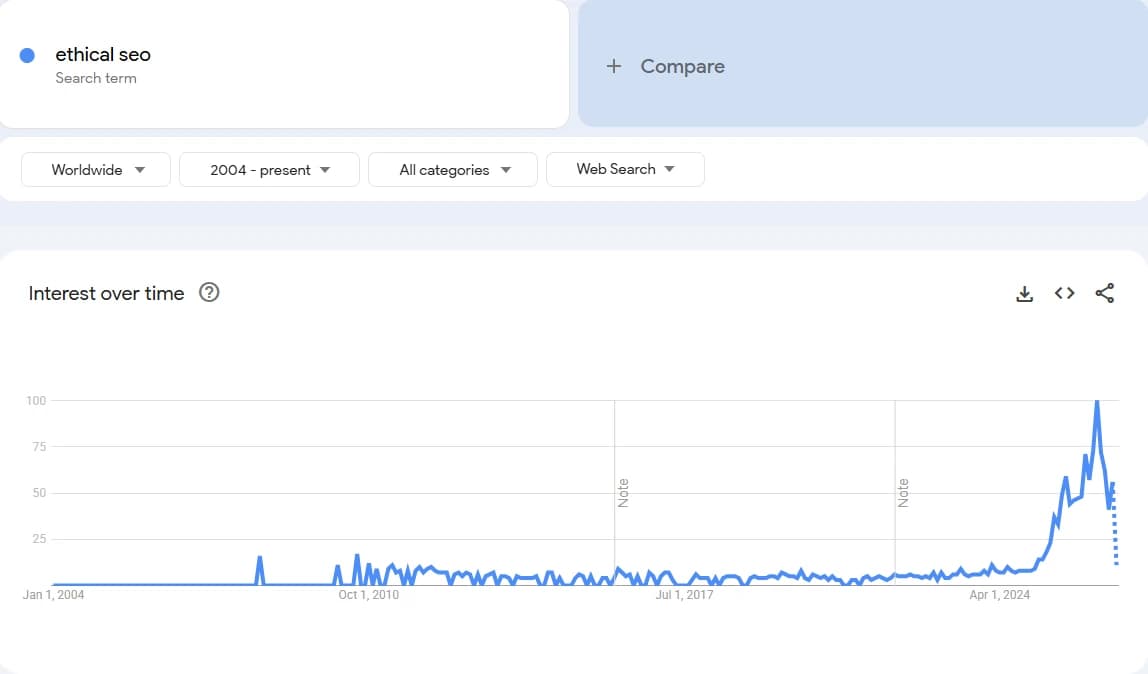
When it comes to ethical SEO, the search trends clearly show that the demand for it has skyrocketed since early 2025, even though the demand was extremely low or non-existent prior to 2025.
My interpretation of this trend is that people have been burnt by unethical SEO practices, have grown tired of seeing short-term results and then losing them after an algorithm update, or both.
White hat SEO
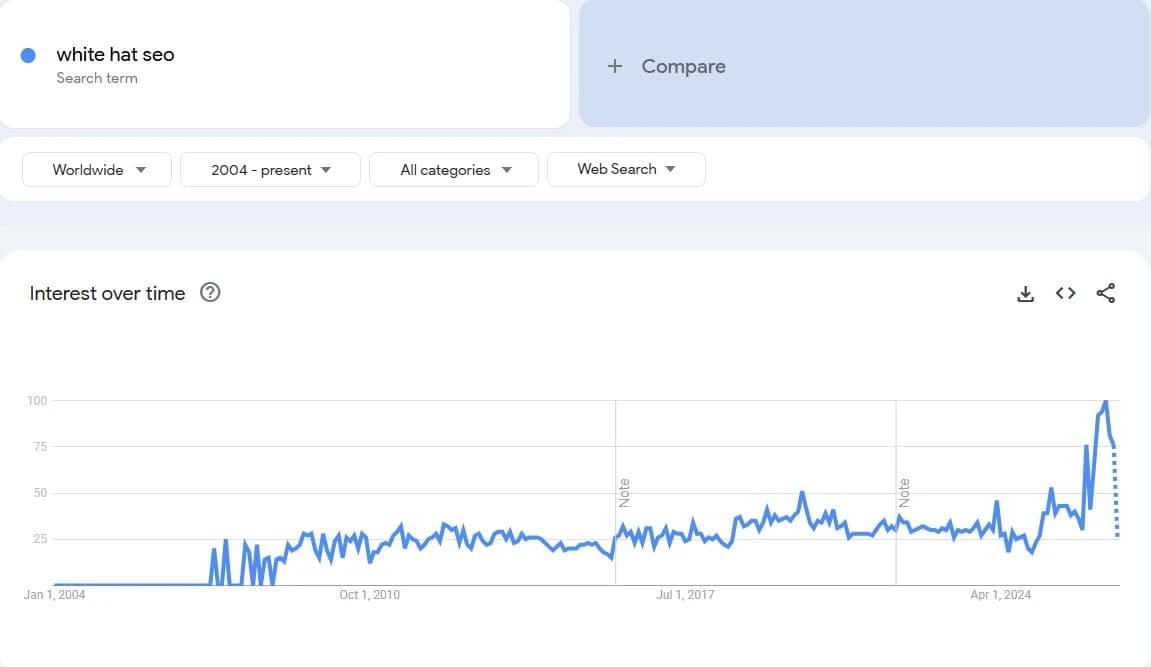
When it comes to white hat SEO, the demand has always been there, with a steady increase over time, but it also skyrocketed at around the same time as ethical SEO.
People are starting to get it. Ethical and white hat SEO are the only sustainable ways forward.
Unethical SEO
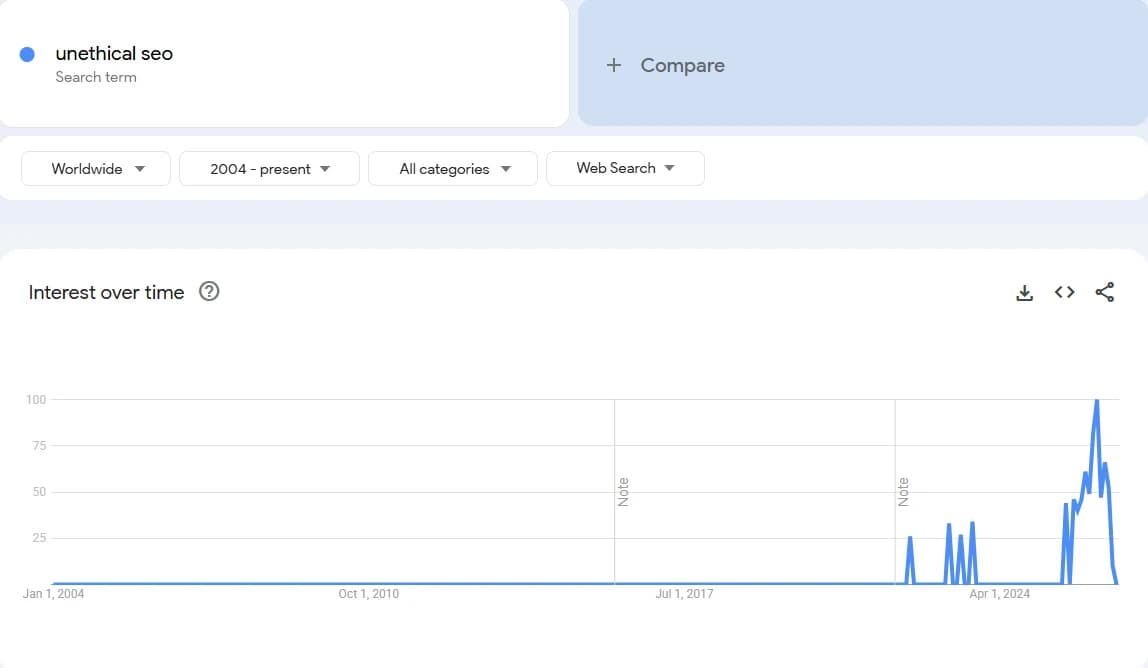
When it comes to unethical SEO, the trend is quite interesting. Even though we see a huge spike in demand for both ethical and white hat SEO, there had never been demand for unethical SEO, but it has also skyrocketed recently.
My interpretation of this trend is that because SEO has gotten harder and harder and websites take longer and longer to rank, a lot of people just don’t have the patience to wait that long anymore and are trying to look for shortcuts.
The thing is, using unethical SEO practices might get you some short-term results, but they will most likely be wiped out by the next algorithm update or, at the very best, you will have the fear of your website getting hit by the algorithm at any moment. It’s just not worth it.
Black hat SEO
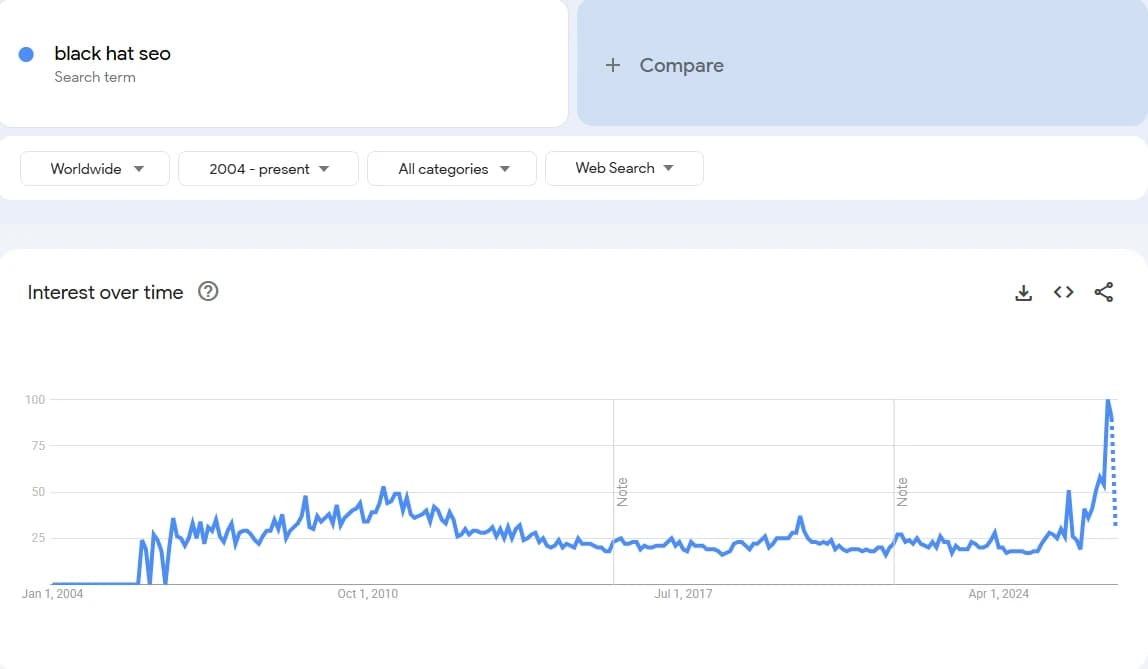
Now, when looking at the trends, I find black hat SEO to be the most interesting.
We can see that it became very popular in the early days of SEO and peaked at around 2011. I wasn’t in the SEO industry back then, as I officially started learning SEO in 2016, but from what I heard, it was a goldmine. If you knew a few tricks, you could rank so easily and make so much money from it that it almost felt illegal.
After 2011, though, the demand for it decreased, with some random spikes here and there, because people realized that these black hat practices wouldn’t last forever. Google started catching up and released one algorithm update after another, with the Panda (2011) and Penguin (2012) updates amongst the most impactful ones, helping to put a stop to the exploitation. This golden era of SEO was good while it lasted, basically, but it’s largely part of SEO history nowadays.
That being said, we see that in recent years the demand for it has skyrocketed again. I believe the reason is exactly the same as the demand for unethical SEO. People no longer have the patience to wait and earn their rankings.
Conclusion
Ethical SEO is, without a doubt, the best way to approach SEO. It’s obviously the most ethical and sustainable approach, and the one you can rely on for long-term success, no matter how many algorithm updates Google releases.
Even though the demand for unethical and black hat SEO has increased in recent years, that is not a sign that either is a good approach or something you should consider.
Nowadays, everyone wants to make money fast, and this behavior is being replicated everywhere. SEO is no exception to that and is obviously one of the areas being affected by it.
Focusing on quality and taking a product-led approach, not only in SEO but in business in general, is the most reliable way to build a solid foundation for your business’s organic growth. Don’t compromise on something as important as this.